If you have ever watched a post-combustion capture unit consume more steam than originally budgeted, seen a project stall because $/ton CO₂ economics did not close, or managed a solvent system that degraded faster than predicted and drove unplanned shutdown — you already understand where the real operating cost of carbon capture lives. It is not the absorber tower. It is the energy penalty of solvent regeneration.
Steam demand for reboiler duty raises fuel consumption, steals power from the host plant, inflates utility bills across every operating hour, and can single-handedly make a project uncompetitive. Advanced solvents — formulated specifically to reduce regeneration energy while keeping capture rate, uptime, and solvent life stable — are the most direct lever available to operators for reducing this penalty. Choosing the best solvent for CO2 absorption for your specific gas conditions and operating constraints is an OPEX decision with compounding financial consequences over the project lifetime.
In this guide you will learn:
What advanced CO₂ absorption solvents are and how they differ from traditional amines
Where energy is consumed in the absorber-stripper loop — and how solvent choice changes it
The system components that solvent chemistry directly impacts
A practical selection framework comparing solvents on an OPEX lens
Industry applications where advanced solvents create the most measurable value
Real operational benefits, honest tradeoffs, and a buyer's checklist
Operational practices that preserve solvent performance over the long term
What Advanced CO₂ Absorption Solvents Are
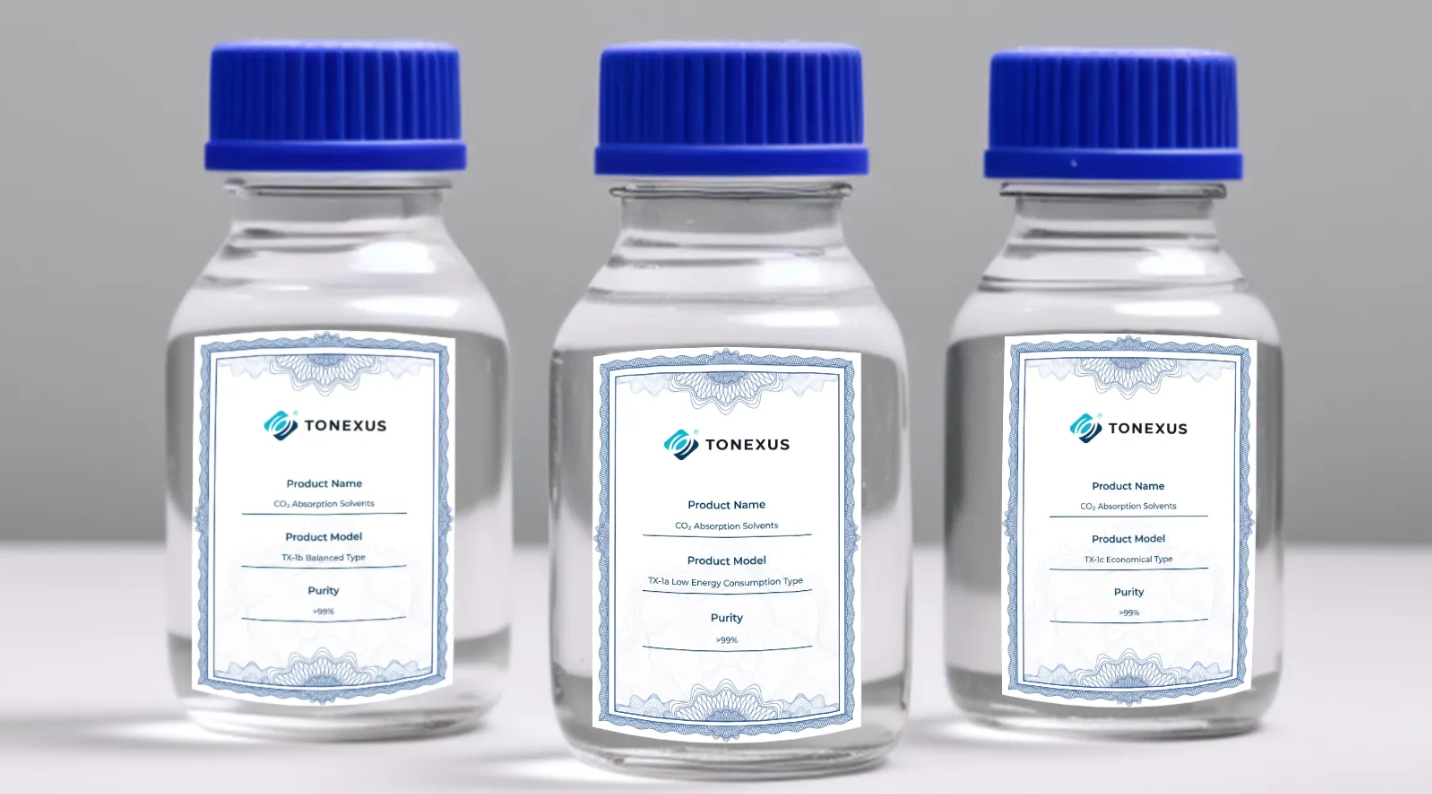
In practical terms, a carbon capture solvent is a formulated chemical solution used in absorber/stripper systems to selectively remove CO₂ from flue gas and release it in a regenerator for compression and storage or utilisation.
The "advanced" distinction — compared to traditional benchmark amines like 30 wt% monoethanolamine (MEA) — typically means optimised chemistry and additives designed to deliver one or more of the following improvements:
Higher cyclic capacity (more CO₂ per kg of solvent per cycle)
Lower heat of absorption (less energy required to release CO₂ in the stripper)
Better resistance to oxidative and thermal degradation
Reduced corrosion tendency at operating concentrations and temperatures
Improved tolerance to flue gas impurities that accelerate solvent breakdown
The best solvent for CO2 absorption in any given installation is not the one with the most impressive laboratory headline — it is the one that delivers the lowest reboiler duty, the lowest solvent makeup cost, and the most stable operation under your specific gas composition, temperature, and impurity profile.
In the field: Most operators evaluating solvent upgrades are not starting from scratch. They are asking whether a different solvent formulation can reduce steam consumption in an existing or planned system without compromising capture rate or adding unmanageable maintenance complexity. That is an OPEX optimisation question, and it requires site-specific data to answer reliably.
How Solvents Reduce CO₂ — and Where Energy Is Actually Spent
Understanding where energy is consumed in the absorption loop is what allows you to evaluate solvent claims with appropriate scepticism and ask the right questions of any carbon capture solvent supplier.
The Absorption Step
In the absorber, CO₂ transfers from the flue gas stream into the liquid solvent phase and reacts or binds chemically with the solvent molecules. The extent of this reaction, how rapidly it occurs (kinetics), and how much CO₂ the solvent can hold at operating conditions (capacity) all depend on the solvent chemistry.
The Regeneration Step
In the stripper, heat is applied — typically through a reboiler using low-pressure steam — to break the CO₂-solvent chemical association, releasing concentrated CO₂ for compression. This is where the energy penalty is paid.
Where Energy Goes
| Energy Sink | Description | Solvent Influence |
|---|
| Sensible heat | Raising solvent temperature from lean to regeneration temperature | Higher cyclic capacity means less solvent circulated per ton CO₂ |
| Reaction heat | Energy to reverse the CO₂-solvent bond | Lower heat of absorption directly reduces this term |
| Stripping steam | Water vapour that carries CO₂ out of the stripper | Affected by operating pressure and solvent volatility |
| Heat exchanger losses | Imperfect heat recovery in the rich/lean exchanger | Solvent thermal stability allows tighter heat integration |
| Reclaimer duty | Additional heat for removing heat-stable salts and degradation products | Lower degradation rate reduces reclaimer frequency and duty |
Why Solvent Choice Is the Lever
Two solvents with identical capture rates can have reboiler duties that differ by 20–35% purely because of differences in heat of absorption, cyclic capacity, and the energy required to circulate the volume of solvent needed per ton of CO₂ captured. This difference, compounded over 8,000 operating hours per year, represents a very large number on the utility bill.
System Components That Solvent Chemistry Directly Impacts
When you select a carbon capture solvent, you are not just choosing a chemical. You are making a decision that propagates through every component in the absorption loop.
| System Component | How Solvent Chemistry Affects It |
|---|
| Absorber (packing, mass transfer) | Absorption kinetics determine required packing height and interfacial area; slow kinetics means a taller tower or lower capture rate at the same footprint |
| Rich/lean heat exchanger | Solvent thermal stability and heat capacity determine how effectively heat can be recovered between lean and rich streams |
| Stripper/reboiler | Heat of absorption and cyclic capacity are the primary determinants of reboiler duty — the main OPEX driver |
| Solvent reclaimer and filtration | Degradation rate determines how frequently reclaiming is needed and how much waste is generated |
| Corrosion control | Solvent chemistry drives corrosion potential at operating concentrations; inhibitor strategy and metallurgy selection follow from this |
| CO₂ product quality | Solvent vapour pressure and carryover affect product purity and downstream compression specification |
What matters in real installations: A solvent that reduces reboiler duty by 15% but doubles the reclaiming frequency and increases inhibitor consumption may deliver a net OPEX neutral or negative outcome. Always evaluate the full operating loop, not just the headline regeneration energy figure.
Selecting the Best Solvent for CO2 Absorption — an OPEX Lens
Selection on an OPEX basis requires comparing solvents across multiple dimensions simultaneously, not optimising on a single metric.
Selection Comparison Framework
| Selection Dimension | What to Request from Suppliers | Why It Matters for OPEX |
|---|
| Regeneration energy | Reboiler duty estimate at your specific operating point (GJ/ton CO₂) | The largest single OPEX driver in most systems |
| Cyclic capacity | kg CO₂ per kg solvent per cycle at operating conditions | Higher capacity = lower circulation rate = lower pump energy and heat duty |
| Absorption kinetics | Mass transfer coefficient and tower performance at your CO₂ % and temperature | Determines whether existing tower packing is adequate or upsizing is needed |
| Degradation rate | Oxidative and thermal degradation rates under your operating conditions | Drives solvent makeup cost and reclaimer frequency |
| Corrosion tendency | Corrosion rate data at operating concentration + required inhibitor strategy | Affects metallurgy investment and maintenance frequency |
| Impurity tolerance | Performance under your O₂, SOx, NOx, and particulate levels | Determines real-world degradation rate vs. clean-gas laboratory data |
| Heat-stable salt formation | Rate of accumulation and reclaiming plan | Ongoing OPEX and periodic shutdown impact |
When AC vs. DC Applies: The Analogous Principle
Just as the best solvent for CO2 absorption is not the one with the best single-parameter performance but the one best matched to your operating conditions, solvent selection requires defining your specific constraints before any comparative claim can be evaluated meaningfully.
Bottom line: Request reboiler duty estimates from every supplier at your actual flue gas composition, CO₂ percentage, capture rate target, and available steam conditions — not at a standard reference case that may not represent your plant. Any supplier who cannot provide a site-specific energy estimate with explicit assumptions is not in a position to make a credible OPEX claim.
Diagram: CO₂ absorption loop showing absorber, rich/lean heat exchanger, stripper/reboiler, CO₂ product stream, and solvent recycle — with callouts identifying where the energy penalty occurs and where advanced solvent properties reduce reboiler duty. Inset: relative reboiler duty comparison between conventional MEA and advanced solvent formulations at equivalent capture rate.
Where Advanced Solvents Create the Most Value
| Industry | Why Advanced Solvents Matter Here |
|---|
| Power and steam boilers | Steam penalty directly reduces net power output; reboiler duty reduction translates immediately to improved plant efficiency and $/MWh economics |
| Cement and lime | High CO₂ concentration streams; significant heat integration opportunities; reducing regeneration energy is critical to project feasibility |
| Steel and refining/petrochem | Complex, variable gas compositions; uptime and stability under impurities are as important as steady-state energy performance |
| Waste-to-energy and industrial boilers | Variable operation modes; contamination concerns from waste-derived flue gas; degradation resistance is often the primary value driver |
What You Gain in Real Operations
| Benefit | What It Means in Practice |
|---|
| Lower steam consumption per ton CO₂ | Direct reduction in utility cost at every operating hour — the most bankable OPEX improvement |
| Smaller reboiler duty or better heat integration | May enable use of lower-grade heat sources and reduce capital intensity in new projects |
| Lower solvent makeup cost | Fewer degradation-driven replacement volumes; less waste to manage and dispose |
| Higher stable capture rates at variable loads | Operational resilience when plant output fluctuates — fewer compliance exceedances |
| Improved project economics | Lower $/ton CO₂ strengthens project bankability and carbon credit economics |
Tradeoffs and Challenges to Expect
| Challenge | What It Means Operationally |
|---|
| Performance is site-specific | Laboratory energy data does not automatically transfer to your gas conditions and operating window |
| Oxygen and impurity sensitivity | Many advanced formulations degrade faster under high-O₂ flue gas; pretreatment quality directly affects solvent life |
| Foaming and aerosol formation | Can raise stack emissions and maintenance burden; requires root-cause management, not just antifoam addition |
| Heat integration limits | Available steam grade and cooling capacity cap the achievable benefit; system audit is needed before claiming full potential savings |
| Solvent transition complexity | Switching from an existing solvent requires flushing, reclaiming, controls re-tuning, and potentially metallurgy review |
Important: Solvent performance claims based solely on clean-gas laboratory data should be treated as an upper bound, not an operating guarantee. Insist on performance estimates that account for your actual flue gas impurity profile and operating temperature range. A qualified supplier should provide these with explicit assumptions and acknowledge uncertainty ranges.
Buyer's Checklist: What to Provide and What to Require
What to Provide to Any Supplier
Flue gas characterisation:
CO₂ percentage (vol%), O₂ percentage, temperature at absorber inlet
Humidity, particulate loading, SOx and NOx concentrations
Any trace contaminants specific to your fuel or process
Operating requirements:
Target capture rate (% CO₂ removal) and CO₂ product specification
Available steam conditions (pressure and temperature)
Cooling water supply temperature and flow limits
Power cost (relevant to pump and compression operating cost)
System constraints:
Existing tower geometry (if retrofit) or allowable footprint (new build)
Allowable pressure drop across absorber
Downtime tolerance and maintenance access frequency
What to Require from Any Supplier
Reboiler duty estimate at your operating conditions, with explicit assumptions documented
Expected solvent loss and makeup rate under your gas conditions
Degradation pathway discussion for your specific O₂ and impurity levels
Corrosion guidance and recommended inhibitor strategy for your metallurgy
Reclaiming plan: frequency, method, waste volume, and disposal route
COA and SDS documentation
Change-control process: how formulation changes are communicated and managed
Operational Practices That Keep OPEX Low
Even the most advanced carbon capture solvent delivers its potential only when operating discipline is maintained. The following practices are the difference between realising the projected OPEX savings and watching them erode over the first operating year.
| Operational Practice | Frequency | What It Protects |
|---|
| Upstream pretreatment monitoring | Continuous/daily | Limits SOx, NOx, particulate carryover that drives degradation |
| Solvent health monitoring (degradation indicators, HSS, metals) | Weekly/monthly | Early detection of degradation trends before performance impact |
| Reclaimer and filtration operation | Per defined schedule | Removes accumulated degradation products that reduce capacity |
| Antifoam strategy and root-cause checks | As triggered | Controls foaming without masking the underlying cause |
| Heat exchanger cleaning | Per maintenance schedule | Preserves heat recovery efficiency — directly impacts reboiler duty |
| KPI tracking | Continuous | Steam/ton CO₂, solvent loss rate, corrosion coupon analysis, capture rate |
Operational best practices:
Establish baseline KPIs in the first 30 days of operation with any new solvent
Track solvent heat-stable salt (HSS) accumulation as an early indicator of degradation before capacity loss becomes measurable
Do not mask foaming with increased antifoam addition without investigating root cause — it typically indicates an upstream contamination issue or solvent degradation
Document all process upsets and correlate with solvent health indicators — this builds the dataset needed for predictive solvent management
FAQs
Q1: What is the largest OPEX driver in a solvent-based carbon capture system?
For most post-combustion capture installations, regeneration heat — specifically the steam or equivalent thermal energy consumed by the reboiler to release CO₂ from the rich solvent — is the single largest operating cost driver. It typically accounts for 50–70% of the total operating cost depending on the local energy price and plant configuration. This is why solvent selection decisions that reduce reboiler duty by even 10–15% can have a disproportionate impact on project economics over a multi-decade operating life.
Q2: What makes the best solvent for CO2 absorption from an OPEX perspective?
From an OPEX standpoint, the best solvent for CO2 absorption is the one that delivers the lowest reboiler duty at your specific operating conditions, combined with adequate cyclic capacity and kinetics, low degradation rate under your actual flue gas impurity profile, manageable corrosion tendency, and stable long-term performance without excessive reclaiming or makeup requirements. No single parameter is sufficient — the evaluation must cover the full operating loop.
Q3: Will a better solvent always reduce energy consumption?
Not automatically. The achievable reduction depends on whether the host plant's heat integration infrastructure — steam supply conditions, rich/lean heat exchanger surface area, cooling capacity — can accommodate the solvent's operating window. A solvent with theoretically lower regeneration energy may not deliver that benefit if the reboiler steam supply is at the wrong pressure or if heat exchanger fouling limits heat recovery. A system audit alongside solvent selection is the only way to confirm achievable savings.
Q4: Do advanced solvents require less maintenance than conventional amines?
Advanced solvents can reduce specific maintenance drivers — particularly if they offer lower degradation rates and reduced corrosion tendency compared to high-concentration MEA. However, they still require systematic solvent health monitoring, scheduled reclaiming, and impurity control. In some cases, advanced formulations are more sensitive to specific impurities than conventional amines, making upstream pretreatment quality more critical, not less.
Q5: What data do I need to receive a reliable solvent recommendation?
A current flue gas analysis including CO₂ percentage, O₂ percentage, SOx, NOx, humidity, and any process-specific contaminants; the target capture rate and CO₂ product specification; available steam conditions (pressure and temperature); cooling water supply temperature and flow limits; power cost; and any geometric or pressure drop constraints on the absorber system. This information allows a supplier to provide an energy estimate at your actual operating point rather than at a standard reference case that may bear little resemblance to your plant.
Ready to Reduce Your Carbon Capture OPEX?
The energy penalty of solvent regeneration is not fixed — it is a function of solvent chemistry matched to operating conditions, heat integration realised in practice, and operational discipline maintained over time. The most bankable path to lower $/ton CO₂ starts with selecting the best solvent for CO2 absorption for your specific flue gas, available utilities, and operating constraints — then verifying that performance with site-specific data, not generic laboratory claims.
To summarise the key decisions:
Evaluate solvents on reboiler duty at your conditions, not on laboratory reference data
Account for the full operating loop: degradation, reclaiming, corrosion, and impurity management all affect net OPEX
Require explicit assumptions with any energy estimate — the assumptions determine whether the number is meaningful
Audit heat integration capability alongside solvent selection — the system must be able to capture the savings the solvent makes available
Establish baseline KPIs early and track them consistently to protect OPEX gains over the operating life
Visit CO₂ absorption solvents and share your flue gas composition, capture target, and available steam and cooling limits to receive an advanced solvent recommendation and an OPEX-focused performance estimate for your carbon capture project.
About the Technical Reviewer
This article was reviewed by the Tonexus process chemistry applications team, with experience in solvent-based carbon capture system design across power generation, cement, steel, and industrial gas applications. Our team assists customers with solvent selection, OPEX modelling, and site-specific performance estimation for both retrofit and new-build best solvent for CO2 absorption programmes. Contact us for application-specific guidance or to request a performance estimate at your operating conditions.
 English